
In recent months, there has been much talk about AI and automation in software development, but one human factor remains crucial: communication. This is where Spec-Driven Development (SDD) comes in. In this post, we will explore what SDD is and how it can help you improve your workflow.
Spec-Driven Development: Towards Predictable and Professional Software Development
If your typical workflow involves implementing logic on the backend and then notifying the frontend team—or retroactively documenting—how the JSON response was structured, you are likely to face inconsistencies and rework. There is a methodology designed to mitigate these risks: Spec-Driven Development (SDD).
1. What is Spec-Driven Development?
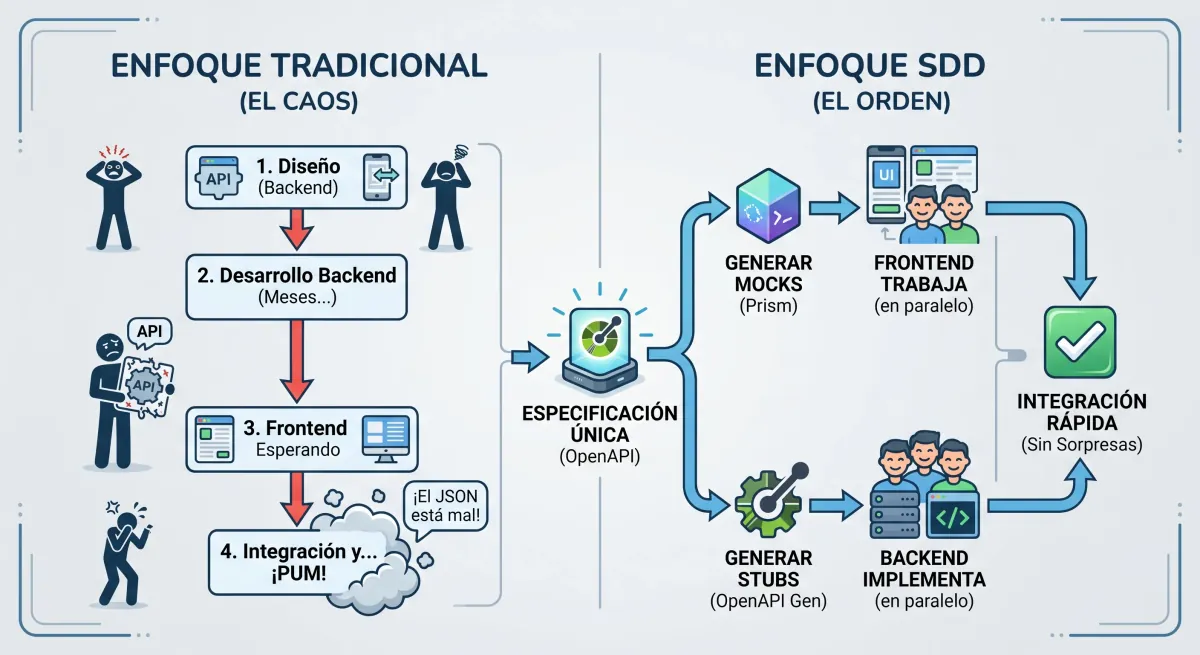
Unlike traditional development, where documentation is often a secondary task performed after implementation, in SDD, the specification is the fundamental pillar.
This approach establishes that the API design (the contract) must precede any implementation code. In practical terms, the team defines the service’s input parameters and response schemas under a standard like OpenAPI (Swagger). This file acts as the single source of truth and governs the development of the entire project.
2. The Workflow: From Specification to Code
The process is methodical and requires technical rigor to ensure success:
- Contract Design: The
openapi.yamlfile is defined, detailing endpoints, data models, response codes, and authentication schemas. - Validation and Consensus: The contract is shared with all stakeholders (architects, frontend developers, and clients). Any necessary adjustments are made to the design, avoiding costly modifications to code already written.
- Stub and Mock Generation: Once the specification is approved, mocking servers can be set up. This allows the frontend team to interact with an interface that simulates real data, enabling them to progress independently while the backend is under development.
- Implementation: The backend team focuses on implementing business logic over the stubs automatically generated from the specification.
3. Benefits of a Specification-Based Approach
Adopting SDD provides critical competitive advantages for the software lifecycle:
- Ambiguity Reduction: Eliminates misunderstandings regarding expected data types and structures. The contract is binding for all parties.
- Parallel Development: Frontend and Backend can start their tasks simultaneously from day one, optimizing delivery times.
- Always Up-to-Date Documentation: Documentation stops being a static document and becomes the technical foundation that generates the service.
- Architectural Consistency: Encourages the use of standards and avoids creating ad-hoc solutions for each endpoint, improving long-term maintainability.
4. Recommended Tooling Ecosystem
To implement SDD successfully, there are consolidated tools that facilitate the process:
- Stoplight Studio: A visual tool for API design that abstracts the complexity of YAML syntax.
- Prism: A utility for instantly deploying mock servers based on the specification file.
- Spectral: A specialized linter for OpenAPI files that ensures compliance with best practices and quality standards.
- OpenAPI Generator: A powerful engine for automating the creation of boilerplate for servers (NestJS, Go, Python) and TypeScript clients.
Conclusion
Spec-Driven Development does not represent an additional workload but rather an investment in efficiency. It is the methodology that distinguishes scalable systems from those that suffer structural failures due to minor changes in the database.
If you value precision and control over your development environment (in the same way you optimize every component of your operating system), SDD is the standard of rigor your workflow needs to reach a superior professional level.